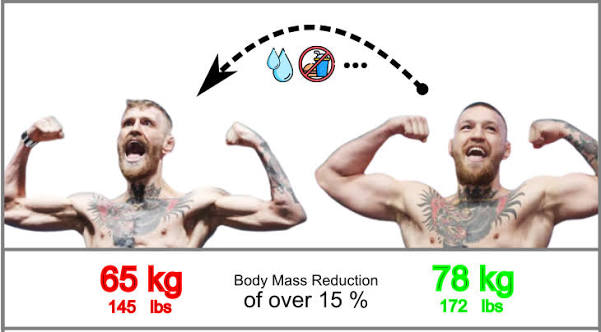
Weight Cutting for MMA: How Pros Do It and What Amateurs Should Copy
The short version: Professional fighters cut large amounts of weight because they have a day to recover, a team running the protocol and a doctor nearby. Amateurs usually have none of those things, and the research shows that the recovery window — not discipline, not toughness — is what determines how much weight an athlete removes. Copy the first half of the professional approach, which is gradual and boring. Leave the second half alone.
Before you read on. This is general information from a competitive athlete, not medical advice. Rapid weight loss and dehydration carry real risks, including death. Your commission’s rules and your doctor’s guidance come before anything written here. If you are under 18, do not attempt any of this without your coach, your parents and a physician involved. See our Medical Disclaimer.
Three deaths in thirty-three days
Modern combat sports regulation begins with a month in the winter of 1997.
Between 7 November and 9 December that year, three previously healthy collegiate wrestlers died in three different American states, each of them in the middle of a rapid weight-loss programme to qualify for competition. In the hours before their official weigh-ins, all three had followed a similar routine designed to promote dehydration through sweating, and all three developed hyperthermia. One of them, 21-year-old University of Michigan wrestler Jeffrey Reese, had been exercising for two hours in an overheated room in a rubberised sweat suit. cdcThe Washington Post
The response was immediate and sweeping. The NCAA rewrote its rules to prohibit laxatives, emetics, diuretics, excessive food and fluid restriction, self-induced vomiting, rooms hotter than 79°F, hot boxes, saunas, steam rooms, vapour-impermeable suits, and intravenous rehydration between the weigh-in and competition. Matches were moved to within an hour of the weigh-in for dual meets and two hours for tournaments, and a certification programme was introduced requiring wrestlers to pass a hydration test and a body composition assessment before the season. www.cdc.gov +2
That is the origin of nearly every weight rule an amateur athlete encounters today. It is worth knowing, because the rules are frequently treated as bureaucratic obstacles by people who have never been told what they are for.
What professional fighters actually do
The professional MMA cut has a recognisable four-stage shape.
The long phase. Most of the reduction is fat loss across the training camp, managed so that performance holds. This is the part nobody films.
Water manipulation. In the final days, some teams manipulate fluid and sodium intake to shed water weight before the scale.
Acute dehydration. The last 24 to 48 hours produce the footage everyone has seen: sweat suits, hot baths, a fighter who looks hollow on the platform.
The refuel. Immediately after weighing in, an intensive rehydration and refeeding protocol runs for as long as the window allows.
The scale of this is not a fringe phenomenon. In a survey of 637 combat sports athletes, at least 85% of every group reported using a weight-loss strategy before competition, and both the prevalence and the magnitude of acute weight loss were greatest in mixed martial arts. Among 138 elite judoka, 96% practised rapid weight loss, losing an average of 5.8% of body mass; 88% used fluid restriction, 85% a sauna suit, and 21% reported having collapsed during the process. Citsnih
The number that should change your mind
Here is the finding that matters most for an amateur, and it is rarely mentioned in the videos.
British researchers compared combat athletes competing under weigh-ins held less than 24 hours before the bout with those given 24 hours or more. The athletes with the longer recovery window habitually cut nearly twice as much — 9.7% of body mass against 5.2% — and their heaviest reported cuts reached 13.0% against 8.7%. Their overall rapid-weight-loss score was substantially higher, and the researchers described the magnitude in the longer-window group as concerning from both a health and a performance perspective. ScienceDirect
Read that again in practical terms. The size of a fighter’s cut is governed largely by how long they have to put the weight back on. Remove the window and the cut has to shrink, whatever the athlete’s willingness to suffer.
Most amateur and regional promotions weigh in on the day. If you are competing under those conditions and copying a protocol designed for a day-before weigh-in, you are not doing a scaled-down version of a professional cut. You are doing the dangerous half without the part that makes it survivable.
Rehydration is not the reset button people assume
There is a second, less intuitive problem: the refuel does not restore you.
A field study following elite kickboxers through a real competition tracked exactly this. The athletes lost an average of 3.1 kg, about 4.2% of body mass, in the week before the official weigh-in, then regained 3.3 kg between the weigh-in and the start of competition. Half were already hypohydrated a week out; 90% were hypohydrated at the weigh-in. And despite regaining all of the weight and more, 90% were still hypohydrated on the day they competed. PubMed Central
Getting the number back on the scale is not the same as getting the athlete back. Weight returns faster than hydration does.
The physiological cost is measurable elsewhere too. A review of studies on kidney function in combat athletes found that creatinine, blood urea nitrogen and urine specific gravity were significantly elevated after rapid weight loss in most of the studies examined — and noted that some athletes repeat the process up to ten times a year. nih
The cases that changed the rules
Three deaths, widely reported, shaped the current regulatory landscape in MMA and adjacent sports.
In 2013, the Brazilian fighter Leandro Souza collapsed after weighing in for a Shooto Brazil event and later died; diuretics were subsequently identified as a factor. In December 2015, 21-year-old Chinese flyweight Yang Jian Bing died of cardiopulmonary failure after complications from a weight cut for ONE Championship. Bleacher ReportBleacher Report
The third case is the one amateurs should read most carefully, because she was one.
Jessica Lindsay was 18, a novice, and attempting to lose 8 kg in seven days for a 64 kg amateur Muay Thai bout in Perth. She collapsed hours before her weigh-in in November 2017 and died in hospital four days later. The coronial inquest heard that she had been following a water-loading protocol; on the day, she drank nothing and trained for hours. A forensic pathologist gave the cause of death as multi-organ failure from the combined effects of hyperthermia and dehydration. The coroner, Sarah Linton, described a sport in which the dangers of weight cutting are well known but generally disregarded because the practice is so common, and recommended that the state’s Combat Sports Commission be given greater power to regulate training outside competition. Jessica Lindsay inquest told teenager died after extreme ‘weight cutting’ for Muay Thai kickboxing fight – ABC News +2
Lindsay’s mother later said her daughter had followed the method as instructed, and that the damage from a single attempt cost her life. Womens Health
Note what is absent from that case: a professional contract, a nutritionist, a medical team, a recovery window. It is the amateur configuration, and it is the one most readers of this article are in.
How the regulators responded
In May 2017 the California State Athletic Commission adopted a ten-point plan against extreme weight cutting. Fighters became licensed by weight class, requiring a physician’s approval to compete at a given weight; those missing weight were fined from both show money and bonuses; and new divisions were introduced at 165, 175, 195 and 225 pounds. The plan also brought in 30-day and 10-day weight checks for approved title fights, to confirm athletes were within safe benchmarks before their final cut. Where a fighter gained more than 10% of body weight between the weigh-in and fight morning, the commission would press for a permanent move up in division. In October 2019 it went further, voting unanimously to cancel bouts where a fighter weighed more than 15% above the contracted weight on the day of the event. California State Athletic Commission +4
Andy Foster, the commission’s executive officer and a former professional fighter, framed the issue as a clear and present danger to the sport and said he intended to act regardless of whether other jurisdictions followed. They largely did: the plan was subsequently endorsed nationally by the Association of Boxing Commissions and adopted in other jurisdictions, including Brazil’s CABMMA. MMA Maniaca
The reason to know this as an amateur is simple. The professionals you are copying are increasingly operating under rules designed to stop them doing what you are about to do unsupervised.
What amateurs should copy
The useful parts of the professional method are the unglamorous ones.
Start eight weeks out. The professional cut works because most of the weight came off gradually during camp. Give yourself the time and the final phase becomes trivial.
Let nutrition do the work. Protein kept high, carbohydrate kept around training, calories trimmed from the edges rather than from your fuel. Roughly 0.5-1% of body mass per week is the standard guidance for losing fat without losing strength alongside it.
Confirm the weigh-in format before you choose a class. Same-day or day-before changes everything about what is achievable. This single question should drive your entire plan.
Plan the refuel in advance. Professionals know exactly what they will drink and eat, in what order. Most amateurs improvise at a petrol station. How to Rehydrate After a Weigh-In
Tell someone what you are doing. The most dangerous feature of an amateur cut is that nobody else knows it is happening. Every case above involved an athlete who was, in the critical hours, effectively unsupervised.
What amateurs should not copy
Sauna suits, hot-bath protocols, extended fluid restriction, water-loading schemes found online, and anything advertised as removing a large amount of weight in 24 hours.
These are the elements that require medical supervision you do not have, and they are the specific practices that appear in the case files. They are also, not coincidentally, the practices the NCAA banned outright in 1998. cdc
If you take one idea from this article: the danger is not proportional to the total weight lost. It is proportional to how fast fluid is removed and how little time there is to put it back.
What a bad cut cost me
I compete in wrestling and grappling rather than MMA, but the mechanics are identical and so is the arithmetic.
Two years ago I made 66 kg for a regional grappling championship. I got there by losing 7 kg over a month and spending the final week barely drinking water and eating almost nothing while I continued to train. I made the weight, which was the only thing that went right.
By the last few days I was moving through sessions on empty. I tore my biceps that week — not in a match, not under a freak load, just an ordinary session in a body with nothing left to absorb it. I competed anyway, won one and lost one. An unremarkable day on paper.
The tear kept recurring. I was out for six months.
What I was running was not a professional protocol. It was a bad imitation of one, without the recovery window, without supervision, and without any of the things that make the professional version survivable. That is the situation most amateurs put themselves in, and it is why this article is written the way it is.
Now I don’t cut water, the weight comes off slowly, and when the margin isn’t there I move up a class — as I am doing for my next competition.
An eight-week plan for amateur MMA
Weeks 8-6. Choose the class where you are strong, not the one where you are lightest. Begin the gradual reduction. Weigh yourself daily at the same time and track the trend, not the day.
Weeks 5-3. You should be within a few percent of your class. If you are not, reassess the class rather than plan a larger cut. Watch training quality: collapsing lifts, poor sleep and repeated illness mean you are moving too fast.
Week 2. Fine-tuning only. Confirm the weigh-in format with the promotion in writing.
Fight week. Reduce digestive residue rather than fluid: less fibre, smaller and more frequent meals, less salt. Keep drinking. If the gap is still large, move up or withdraw.
Weigh-in day. Weigh in, then refuel gradually — fluid with electrolytes first, then easily digested carbohydrate, then a real meal once the stomach settles. How aggressive you can be depends entirely on the clock.
Warning signs
Stop and speak to a medical professional if you experience dizziness or fainting, confusion or trouble concentrating, a racing heart at rest, cramping that will not resolve, very dark urine or no urination, nausea and vomiting, or chest pain. In a hard cut these are often dismissed as part of the process. They are not.
There is also a longer-term dimension that the sport talks about less. In one review, 10-20% of wrestlers reported feeling unable to control themselves while eating — a recognised symptom of disordered eating — rising to 30-40% after competition. A study of Lithuanian combat athletes found that participants had begun weight cycling as young as nine, with an average starting age of under 13. If the way you think about food or the scale has started following you outside fight camp, that is worth raising with someone. Citsnih
Frequently asked questions
How much weight do professional fighters cut?
Reported figures vary widely and are frequently exaggerated in interviews. The research finding that matters is that athletes with a 24-hour-plus recovery window habitually cut around 9.7% of body mass, against 5.2% for those weighing in on the day. The window, not the willpower, sets the number. ScienceDirect
Can I cut weight for a same-day weigh-in?
Only trivially. You compete in the state you weighed in. And even with a recovery window, most athletes in one field study were still dehydrated on competition day despite having regained all the lost weight. PubMed Central
Is water loading safe?
The protocols circulating online were designed for supervised settings and carry serious risks. It was the method Jessica Lindsay was following when she died. The Courier Mail
What if I miss weight?
It depends on the promotion and the commission. In California, fighters who miss weight are fined from their show money and any bonuses, and penalties elsewhere range up to cancellation of the bout. Know the rule before you sign. Bleacher Report
Should I just fight one class higher?
At amateur level, usually yes. Very few amateur careers have been damaged by competing one division up. A considerable number have been damaged by cutting.
Written by Victor Vicente, national-level competitor in Spain.
Last updated: 28 September 2026
Sources
- Hyperthermia and Dehydration-Related Deaths Associated with Intentional Rapid Weight Loss in Three Collegiate Wrestlers, CDC MMWR (1998)
- Weight-loss methods probed after 3 college wrestlers die, The Washington Post (1997)
- A comparison of rapid weight loss practices within combat sport athletes subjected to <24 hour vs ≥24 hour competition weigh-ins, ScienceDirect
- Acute weight cycling and hydration status in elite kickboxers, PMC
- Effects of Rapid Weight Loss on Kidney Function in Combat Sport Athletes, PMC
- Rapid weight loss among elite-level judo athletes, PMC
- The Association between Rapid Weight Loss and Body Composition in Elite Combat Sports Athletes, PMC
- Contestant Safety Strategy to Address Rapid Weight Loss by Dehydration, WA Combat Sports Commission
- Jessica Lindsay inquest, ABC News (2020)
- WA coroner’s findings and recommendations, ABC News (2020)
- ONE Championship fighter Yang Jian Bing dies after cutting weight, Bleacher Report (2015)
- California passes new weight-cutting regulations, Bleacher Report (2017)
- CSAC meeting minutes on the 10-Point Plan (2018)
- California State Athletic Commission, regulatory summary