Water Cutting Explained: How It Works and Why It Is Risky
What water cutting actually is
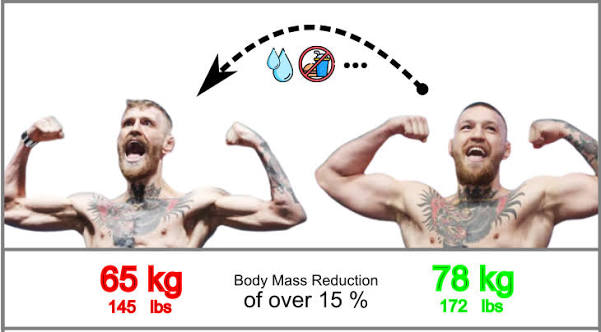
When the scale drops fast in fight week, the weight is coming from one of four places. Water cutting is the riskiest of the four, because it drains what keeps you cool, keeps your blood moving and protects your brain.
Water makes up around 60% of the human body, and probably more in athletes because they carry more lean tissue (Reale, Gatorade Sports Science Institute). For a 70 kg (154 lb) athlete, that is roughly 42 kg (93 lb) of water. It is the biggest reservoir in the body and the one that can change fastest, which is exactly why it is the one people reach for.
| Where the weight comes from | How it drops | Typical size | Cost |
|---|---|---|---|
| Fat (and sometimes muscle) | Eating less over weeks | 0.5-1% of body mass a week if done properly | None if gradual; strength loss if rushed |
| Gut content | Less fiber and smaller meals for about two days | Around 1.5% of body mass | Uncomfortable, not dangerous |
| Glycogen (stored carbohydrate) | Cutting carbohydrate; each gram of glycogen holds about 2.7 g of water | Around 2% over a week | Less fuel for hard efforts |
| Body water | Drinking less, sweating more, cutting salt, water loading | 1.5-2% from one day without fluid; more with sweating | Performance, heat illness, kidneys, and in the worst cases death |
The gut, glycogen and fluid figures come from the same review (Reale, GSSI). Its author, a sports nutritionist who works with combat athletes, is blunt about the last row: using dehydration alone to drop 5-8% of body mass is inadvisable and dangerous.
Water cutting is the bottom row. Everything else in this article is about why it is so tempting, how it works, and why it costs far more than the number on the scale suggests.
How water cutting works
Every water-cutting method does one of two things: it puts less water in, or it pushes more water out. Most cuts stack several of them, and that stacking is where the risk compounds.
Drinking less
The simplest version is fluid restriction. A full day on less than 300 ml (10 oz) of fluid takes off around 1.5-2% of body mass (Reale, GSSI). For a 70 kg (154 lb) athlete, that is roughly 1-1.4 kg (2-3 lb).
For someone planning a big cut, that is rarely enough. So restriction usually gets combined with the methods below.
Water loading
Water loading is the method that sounds clever. For several days the athlete drinks far more than normal, then cuts intake sharply before the weigh-in.
The logic is hormonal. When you drink a lot, your body turns down vasopressin, the hormone that tells your kidneys to hold on to water. When the water suddenly stops, the kidneys take time to catch up, so you keep urinating for a while after you have stopped drinking (Reale et al., 2018).
There is one controlled study on it, with 21 male combat athletes on a fixed diet under supervision. Water loading before a day of restriction produced a body-mass loss of 3.2%, against 2.4% for restriction alone (Reale et al., 2018). That gap is under 1% of body mass: about half a kilo (1 lb) for a 70 kg athlete. Days of discomfort for one pound.
Under those lab conditions, with food and salt controlled and blood tests throughout, nobody developed hyponatremia, a dangerously low blood sodium level. That is the only safety data there is. The versions passed around gyms tend to push the volumes higher, cut salt at the same time and skip the blood tests. Researchers had flagged that exact combination of water loading and salt restriction as a possible hyponatremia risk (McCubbin, 2025), and the extreme versions have never been tested.
Water loading was also part of what an 18-year-old amateur Muay Thai fighter in Australia was doing when she collapsed and died in 2017. Her case is covered in our article on weight cutting for MMA.
Cutting salt
Your kidneys balance water against sodium, so the theory is that cutting salt releases water. The evidence is thin. In one study, three days of restricted salt took 0.6 kg (about 1.3 lb) off endurance athletes, but their total body water did not change, and a 2025 review concludes it is still unclear whether salt restriction works for making weight at all (McCubbin, 2025).
In practice, salt cutting is mostly used to amplify water loading. That is exactly the combination flagged above.
Sweating it out
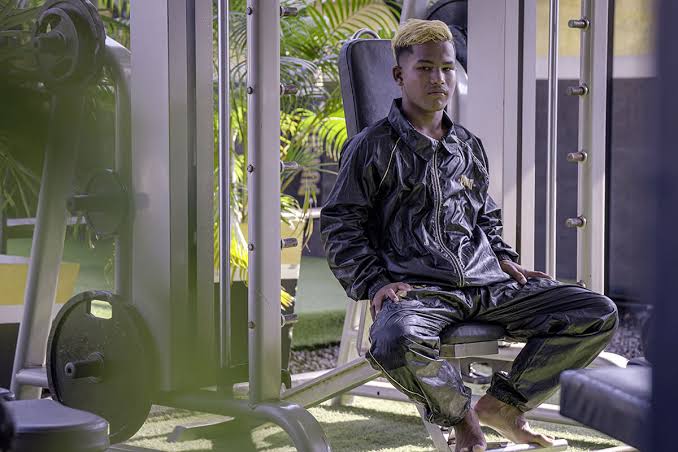
Sweating is the oldest method and the one that shows up most in the case files. It comes in two forms: active (training, often in extra layers) and passive (saunas, hot baths, sweat suits while resting).
They are not equivalent. Passive sweating before exercise lowers plasma volume and the amount of blood the heart pumps per beat, and raises heart rate and stored body heat more than active sweating does (Reale, GSSI). In plain terms, you start your session already hot, with less blood to cool yourself.
The three college wrestlers who died within five weeks of each other in 1997 had all been sweating weight off in heat. The NCAA’s response banned saunas, steam rooms, rooms hotter than 79°F and rubber or vapor-impermeable suits (CDC MMWR). [link: Sauna Suits for Weight Cutting: Do They Work and Are They Safe?]
Pills
Diuretics force the kidneys to dump water. They are prohibited at all times, in and out of competition, on the WADA Prohibited List, and most US state athletic commissions ban them too (Bleacher Report).
They are also the method behind one of the starkest cases in MMA. In 2013, Brazilian fighter Leandro Souza accepted a fight that required dropping 33 lb (15 kg) in a week. He reportedly used diuretic pills, collapsed while waiting to weigh in, and died; the cause of death was given as a stroke (Bleacher Report).
Why water cutting is risky
The water you drain is the water your body uses to cool itself, keep your blood moving, clear waste through the kidneys and cushion your brain. Each of those fails in its own way.
Your performance drops
Sports nutrition research treats losses under about 2% of body mass as unlikely to hurt performance, but larger losses become a problem, especially when there is little time to rehydrate (Reale, GSSI). Even at 2%, the cost can show: in elite karate athletes, a 2% loss from a day of fluid restriction significantly reduced jump height (Nutrients, 2025).
Many fighters compete in exactly that state. A 2013 study found that 39% of MMA fighters went into competition significantly or seriously dehydrated (Bleacher Report). One UFC lightweight who cut as much as 30 lb in fight week admitted in the same report that he would lose to anyone if he had to fight on the day he weighed in.
You overheat
Less body water means less sweat and less blood flowing to the skin, so you lose the ability to dump heat. Passive sweating makes it worse, because you start the next session already hot. The three college wrestlers who died in 1997 all developed hyperthermia while sweating weight off (CDC MMWR).
It does not take a huge final cut. One of those wrestlers was trying to lose 4 lb (1.8 kg) in about four hours, the day before a tournament. His temperature at the time of death was 108°F (42°C) (CDC MMWR).
Your kidneys take the hit
Dehydrated blood is thicker, and the kidneys have to work harder to filter it. A review of studies on combat athletes found markers of kidney strain (creatinine, blood urea nitrogen, urine specific gravity) significantly raised after rapid weight loss in most of the studies it examined. Some athletes go through that up to ten times a year (Effects of Rapid Weight Loss on Kidney Function, PMC).
The best-known example is a wrestler. Daniel Cormier suffered kidney failure while cutting weight for the 2008 Beijing Olympics and could not compete (Bleacher Report).
Your brain has less protection
Your brain sits in cerebrospinal fluid, which acts as a cushion. Neurosurgeon Robert Cantu has explained that dehydration shrinks that fluid layer, leaving the brain more room to move inside the skull when you take an impact (Bleacher Report). Nobody can test this directly, because the experiment would be unethical. But doctors who work in combat sports broadly accept that dehydrated fighters face a higher concussion risk, and Western Australia’s Combat Sports Commission lists increased risk of brain injury among the harms of weight cutting (WA Combat Sports Commission).
This is not just a striking problem. Takedowns, slams and head contact with the mat count too.
Too much water is dangerous as well
Water cutting creates two moments when people drink huge amounts of plain water: the loading phase, and the panic refill after the weigh-in. Both can dilute blood sodium. The danger of hyponatremia is that fluid moves into cells, and the cells that swell are in the lungs and brain (McCubbin, 2025).
The worst case
The names are in our MMA weight cutting article: three college wrestlers in 1997, Leandro Souza in 2013, Yang Jian Bing in 2015, Jessica Lindsay in 2017. Every one of those deaths involved removing body water fast. None of them involved losing fat slowly.
Why drinking it back doesn’t undo it
The usual defense of water cutting is that you put it all back after the weigh-in. The scale does recover in hours. Your body does not.
The field data is consistent. Elite kickboxers followed through a real competition lost an average of 3.1 kg (4.2% of body mass) in the week before weighing in, then regained 3.3 kg before they fought. Despite putting back more than they lost, 90% were still hypohydrated on competition day (BMC Sports Science, Medicine and Rehabilitation, 2026). An earlier study of elite wrestlers, judoka, boxers and taekwondo athletes found 89% hypohydrated on the morning of competition, and the athletes who weighed in the evening before, with a whole night to drink, were no better off (IJSNEM, 2014).
Three things get in the way:
- You keep losing water while you drink. Part of what you drink comes straight back out as urine, so you need to drink 125-150% of what you lost just to break even (Reale, GSSI). That is a lot of fluid to sit in your stomach before a match.
- You don’t know your real deficit. The weight you dropped is a mix of water, gut content and glycogen, so the number on the scale overstates or understates how much fluid you actually need (Reale, GSSI).
- Weight returns before hydration does. Food and fluid sitting in your gut count on the scale long before that water reaches your muscles and brain.
If you weigh in on the day, as in most BJJ events, none of this has time to happen. We cover that case in how to make weight for a BJJ tournament. [link: Same-Day vs Day-Before Weigh-Ins] [link: How to Rehydrate After a Weigh-In]
How the rules caught up with water cutting
The organizations that have looked hardest at water cutting reached the same answer: test for it. The tool is urine specific gravity, a measure of how concentrated your urine is. Plain water reads 1.000, and readings above about 1.020 indicate dehydration (Bleacher Report).
| Who | What it does about water cutting | In force since |
|---|---|---|
| NCAA college wrestling | Bans saunas, steam rooms, rooms hotter than 79°F, vapor-impermeable suits, diuretics, excessive fluid restriction and IV rehydration between weigh-in and competition (CDC MMWR) | 1998 |
| US high school wrestling (NFHS) | Every state program must run a hydration test, with specific gravity no higher than 1.025, right before the body-fat test that sets a wrestler’s minimum weight; weight loss is then monitored at 1.5% of body weight a week (Curby, International Journal of Wrestling Science) | 2006-07 season, in its current form |
| ONE Championship (MMA, Muay Thai, kickboxing) | Weight classes assigned from daily tracked weight; daily weigh-ins and urine specific gravity tests through fight week, up to three hours before the event; fail either and you are out of the event; no IVs (Sherdog) | January 2016 |
| California State Athletic Commission (MMA, boxing) | Weight-class licensing with a doctor’s approval, fines for missing weight and extra divisions; details in our MMA weight cutting article | 2017 |
ONE introduced its system weeks after Yang Jian Bing’s death. Its vice president, former UFC champion Rich Franklin, later summed it up: «We don’t use the term weight cutting because there is no cutting» (MMA Mania).
The high school test has a specific purpose worth understanding. It runs immediately before the body-fat assessment so that nobody can get certified at a lower minimum weight by showing up dehydrated (Curby). If you find yourself wondering how to beat the test, you are working on the wrong problem.
What the water part cost me
Two years ago I made 66 kg for a regional grappling championship. I lost 7 kg over the month before it, and the last week was the water part: barely drinking, eating almost nothing, and still training.
On paper it worked. The scale said 66. In practice, by the end of that week I was moving through sessions like a zombie, and I tore my biceps in an ordinary training session. No freak load, no match, just a body with nothing left to absorb it.
After weighing in I got some water and food back in and recovered enough to function. Enough to win one match and lose one. Not enough to be the athlete I had spent months training to be. Then came six months out, with a tear that kept coming back.
The month of dieting too fast had already cost me. The week without water took what was left, and in exchange gave me a number on a scale that lasted a few hours.
These days I don’t cut water. The weight comes off slowly through how I eat, and when the margin isn’t there, I move up a class.
[Nota para Victor, borrar antes de publicar: esta sección usa solo lo que ya contaste en los artículos anteriores. Es la parte que más pesa para Google y para Amazon, así que conviene añadir 2-3 detalles concretos de esa semana sin agua que no estén en los otros artículos: cómo dormías, si tenías calambres o dolor de cabeza, cuánto bebías al día, qué bebiste justo después del pesaje y cómo te sentó. Si alguna vez probaste el water loading, cuéntalo aquí.]
What to do instead
The alternative to water cutting is not a smarter water cut. It is arriving at fight week with almost nothing left to lose.
- Pick your class at your hydrated weight. Not your lightest morning after a dry evening. Run the numbers in our weight cut calculator to see whether the class is realistic in the time you have.
- Lose the gap slowly. High school wrestling caps weekly loss at 1.5% of body weight (Curby), and 0.5-1% a week is a better pace if you want to keep your strength. The week-by-week version is in our wrestling weight cut guide.
- In fight week, cut what is in your gut, not your blood. Less fiber and smaller meals over the last couple of days can take off around 1.5% of body mass without touching your hydration (Reale, GSSI). Keep drinking normally.
- Confirm the weigh-in format before you choose a class. Same-day or day-before changes what is achievable. [link: Same-Day vs Day-Before Weigh-Ins]
- Plan your refuel in advance. Fluid with sodium is retained better than plain water. Oral rehydration solutions carry more sodium than standard sports drinks, or you can pair a sports drink with salty food (Reale, GSSI). Know exactly what you will drink before you step on the scale. [link: Best Electrolyte Drinks for Fighters After Weigh-Ins] [link: How to Rehydrate After a Weigh-In]
- Weigh yourself the same way every day. Same time, same scale, same conditions. A trend over weeks tells you far more than any single morning. [link: Best Scales for Tracking Weight Before a Weigh-In]
- If water is the only way to make the class, move up. That is the decision every rule in the table above is trying to force. You can make it yourself.
If you are under 18: no water cutting, at all. You are still growing, and the hydration testing in high school wrestling exists precisely to stop it. Make weight decisions with your coach, your parents and a physician. [link: Youth Wrestling Weight Management: A Guide for Parents]
Warning signs
Stop and get medical help if you experience dizziness or fainting, confusion or trouble concentrating, a racing heart at rest, cramping that won’t resolve, very dark urine or no urine at all, nausea and vomiting, or chest pain. In a hard cut these get dismissed as part of the process. They are not.
One warning is specific to water loading. If you have been drinking very large volumes and develop a headache, nausea or confusion, that can be low blood sodium rather than dehydration, and drinking more plain water makes it worse. Get help rather than guessing.
And if the way you think about food, water or the scale has started following you outside the season, that is worth talking to someone about. It is far more common in weight-class sports than most gyms admit.
Frequently asked questions
Does water loading actually work? A little. In the only controlled study, it added under 1% of body mass to a day of fluid restriction, roughly half a kilo (1 lb) for a 70 kg athlete. The only safety data comes from that supervised version (Reale et al., 2018).
How much water weight can you lose in 24 hours? Around 1.5-2% of body mass from drinking almost nothing for a day (Reale, GSSI). Anything beyond that comes from sweating, which is where the case files come from. If your plan needs more than that, the plan is the problem.
Is a sauna safe for cutting weight? Saunas have been banned in NCAA wrestling since 1998 (CDC MMWR). Passive heat raises your heart rate and body temperature more than training does (Reale, GSSI), and it leaves you hotter going into your next session.
How long does it take to rehydrate after a water cut? Longer than the scale suggests. Elite kickboxers who regained more weight than they had cut were still mostly hypohydrated on competition day (BMC Sports Science, Medicine and Rehabilitation, 2026).
Is water weight the same as real weight loss? No. It comes back as soon as you drink. That is the whole appeal and the whole problem: water cutting changes the number for a few hours, not your body.
Can diuretics help me make weight? They are prohibited at all times on the WADA Prohibited List, banned in NCAA wrestling, and were reportedly involved in the death of Leandro Souza in 2013 (Bleacher Report). No.
Written by Victor Vicente, national-level competitor in Spain. Last updated: 5 October 2026
Sources
- Acute Weight Management in Combat Sports: Pre Weigh-In Weight Loss, Post Weigh-In Recovery and Competition Nutrition Strategies, Gatorade Sports Science Institute, Sports Science Exchange #183 (2018)
- The Effect of Water Loading on Acute Weight Loss Following Fluid Restriction in Combat Sports Athletes, International Journal of Sport Nutrition and Exercise Metabolism (2018)
- Sodium intake for athletes before, during and after exercise: review and recommendations, Performance Nutrition (2025)
- The Effect of Acute Dehydration upon Muscle Strength Indices at Elite Karate Athletes, Nutrients (2025)
- Effects of Rapid Weight Loss on Kidney Function in Combat Sport Athletes, PMC
- Acute weight cycling and hydration status in elite kickboxers: a repeated-measures field study, BMC Sports Science, Medicine and Rehabilitation (2026)
- Hydration Status in Elite Wrestlers, Judokas, Boxers, and Taekwondo Athletes on Competition Day, International Journal of Sport Nutrition and Exercise Metabolism (2014)
- Hyperthermia and Dehydration-Related Deaths Associated with Intentional Rapid Weight Loss in Three Collegiate Wrestlers, CDC MMWR (1998)
- A Review of the Minimum Wrestling Weight Procedures Used in American Scholastic Wrestling, International Journal of Wrestling Science (2012)
- WADA Prohibited List
- Weight Cutting: Solving ‘The Biggest Problem in Combat Sports’, Bleacher Report (2015)
- One Championship Adopts New Weigh-In Policy Following Recent Fighter Death, Sherdog (2015)
- Here’s how ONE Championship abolished weight cutting in MMA, MMA Mania (2017)
- Contestant Safety Strategy to Address Rapid Weight Loss by Dehydration, WA Combat Sports Commission